
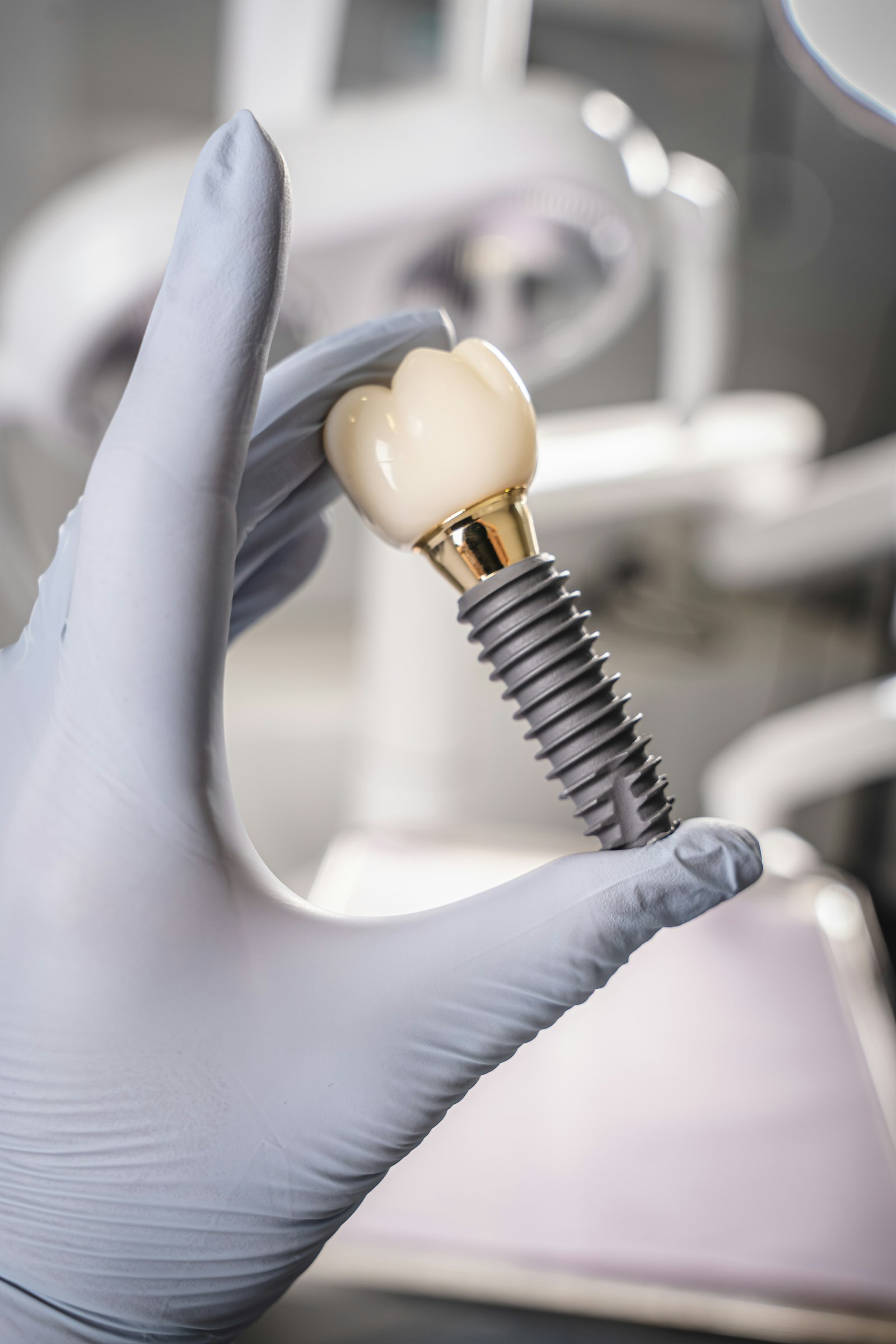
An implant is two objects with two different working lives, and most of the confusion about lifespan comes from talking about them as one. The titanium fixture in the bone is designed to stay where it is and, in a mouth that is looked after, frequently does for decades. The crown screwed or cemented on top is a manufactured object in a wet, loaded, chemically aggressive environment, and it is the part that gets replaced. Ask how long an implant lasts and the useful answer is: which part, and under what conditions.
| Part | What it is | What usually ends its life | Cover |
|---|---|---|---|
| Fixture | The titanium screw in the jaw | Bone loss around it, driven by inflammation or overload | 5 years written, plus the manufacturer’s own programme |
| Abutment and screw | The connector between the two | Screw loosening or, rarely, fracture under heavy grinding | Serviceable: components are replaced, not the implant |
| Crown or bridge | The tooth you see and chew with | Chipping, wear, a fractured ceramic edge, the margin failing | 5 years written |
| The gum around it | The seal that keeps bacteria out | Daily cleaning, or the absence of it | Not a component; it is the maintenance |
If you already have implants and want to know what state they are in, send us a recent panoramic X-ray and a photograph in daylight. The dentist who will treat you will tell you what he can see about the bone level and what is worth watching.
The fixture: why it either lasts a very long time or fails early
Fixture failures cluster at two ends of the timeline and the middle is quiet. Early failure means the bone never grew onto the implant properly, and it shows up in the first months rather than the first decade. The causes there are surgical and biological: insufficient stability at placement, an infection in the site, a smoker’s compromised blood supply, loading the fixture before it was ready.
Late failure is a different mechanism. Bone recedes from around the implant over years, usually because inflammation has been sitting in the tissue at the neck of it. An implant has no root and none of the attachment fibres a natural tooth defends itself with, so the seal between gum and titanium matters more than it does around a natural tooth, and cleaning under and around the crown every single day is the thing that protects it. This is not a small detail dressed up as advice. It is the single largest difference between an implant at fifteen years and an implant at five.
The middle years are quiet because nothing is happening. Titanium does not decay, it does not develop cavities, and bone that has integrated stays integrated as long as nothing irritates or overloads it.
What actually causes late failure, roughly in order
** Not brushing, which most people do. The interdental brush, the floss threader under a bridge, the water flosser: the tools that reach the surface under the crown where a natural tooth would have been protected differently.
** It affects both ends of the timeline, healing at the start and tissue health afterwards, which is why we raise it before treatment rather than after.
** An implant does not feel load the way a natural tooth does, so a heavy grinder can overload one without noticing. A night guard is not a sales line; it is the cheapest insurance on the whole treatment.
Uncontrolled diabetes, where wound healing and tissue response are both affected. Controlled diabetes is a planning detail rather than a risk factor of this kind.
** Bone changes hurt nobody in the early stage and are visible on an X-ray long before they are visible in a mirror. An annual examination catches them while they are still reversible.
The crown is the part with the realistic replacement date
Ceramic is hard and brittle. It resists wear extremely well and it can chip, and over ten or fifteen years of chewing, a crown accumulates the small events that eventually mean remaking it: a chipped edge, a worn contact point, a shade that no longer matches the neighbouring teeth as they age, a loosened screw that has been retightened twice. Remaking a crown on a sound fixture is a straightforward job and a fraction of the original cost, because everything under the gum stays where it is.
That is the arithmetic worth understanding when you compare an implant with a bridge. The implant is the expensive part and it is the part you buy once. The bridge is cheaper and it takes two neighbouring teeth with it when it eventually fails. We set that comparison out properly, over a fifteen-year horizon, on implant or bridge.
Ask us for the written guarantee terms before you commit, not after. WhatsApp +355 69 691 1118 and say which treatment you are considering; you will get the document with the years, the conditions and the exclusions in it.
What the numbers do and do not tell you
Published survival figures for implants are high, and they are averages across studied populations under study conditions. They tell you the technique is sound. They do not tell you what your implant will do, because the variables that matter most are the ones you control: cleaning, smoking, the guard, the check-up. A clinic quoting a percentage at you without mentioning any of those four is quoting a statistic as if it were a promise.
We would rather publish our own numbers than borrow somebody else’s, and that means waiting until there are enough years behind this clinic’s own cases for the figure to mean anything.
The other thing a number cannot cover is service. In eleven years you may need a screw, an abutment or a component that has to match what is in your jaw. A widely used system from a manufacturer that is still trading is far easier to service than an obscure one, which is a large part of why the fixture system is named and its lot number recorded on your plan. What we place and at what price is on the dental implants page, and what the written guarantee covers alongside the manufacturer’s own programme is on the guarantee and aftercare page.
The honest sentence
An implant placed in adequate bone, cleaned properly every day, protected from grinding and checked once a year has a very good chance of still being in service in twenty years, and its crown will probably have been replaced once in that time. That sentence has four conditions in it, and any version of it without conditions is marketing rather than dentistry.
FAQ
Do dental implants last a lifetime?
Nobody can honestly say that about any implanted device, and a clinic that does is making a claim it cannot stand behind. What is true is that the titanium fixture has no biological expiry date: it does not decay and, once integrated, it is stable as long as the bone around it stays healthy. Many implants placed in the 1990s are still functioning. The crown on top is a different object with a shorter working life, and planning for one replacement over a couple of decades is the realistic expectation.
What are the first signs that something is wrong?
Bleeding when you clean around the implant, a gum that looks puffy or has receded at the neck of the crown, a bad taste or smell that persists, any movement at all in the crown, and pressure or discomfort when you bite on it. Movement is the one to act on immediately, because a loose screw caught early is a ten-minute job and a loose screw left for six months can damage the internal thread. Photograph it in daylight and send it rather than waiting for your next appointment.
Does an implant crown need replacing more often than a crown on a natural tooth?
Not because it sits on an implant. In practice implant crowns often last longer, for the simple reason that the thing most likely to end a crown on a natural tooth is decay at the margin, and there is no tooth under an implant crown to decay. What implant crowns are more exposed to is mechanical load, because the fixture does not have the shock absorption a natural root provides. So the failure mode shifts from decay towards chipping and screw loosening, both of which are repairable.
My implant was placed abroad years ago and I want it checked. Can you do that?
Yes, and it is a common request. Send a recent panoramic X-ray, a photograph and whatever documentation you have about what was placed, including the system name and lot number if you have them. You will get a written opinion on the bone level, the fit of the crown and anything worth watching. Work we did not place is outside our guarantee for obvious reasons, and we will say plainly what can be maintained, what should be remade and what is fine as it is.
Use the quote form to send a recent X-ray and a note of when your implants were placed. The dentist who will treat you reviews it personally and you receive a written assessment by e-mail within 24 hours, with no obligation attached to it.
*